A liquid biopsy platform combining a high fundamental frequency QCM device with dynamic chemistry for detecting mutations in circulating DNA

Authors: A. Grammoustianou, G. Papadakis, M. Tabraue, J.J. Díaz-Mochon, R. Fernández, J.V. García, A. Arnau, E. Gizeli. AWSensors S.L., Institute of Molecular Biology and Biotechnology- FORTH, University of Crete, Destina Genomics S.L., Centro de Investigación e Innovación en Bioingeniería – Universidad Politécnica de Valencia

Event:  5th International Conference on Bio-sensing Technology, Riva del Garda, Italy (2017)

In the past decade, the analysis of circulating tumour DNA (ctDNA) in blood has been a major breakthrough; ctDNA has been proposed as a priceless source for cancer diagnostic, prognostic and treatment monitoring through a new methodology known as “Liquid Biopsy”. This study presents a novel diagnostic method for the acoustic detection of KRAS mutations in ctDNAs based on: (1) DNA analysis by “dynamic chemistry” that utilizes aldehyde modified nucleobases (SMART) and abasic peptide nucleic acids (DGL probes) capable for the errorfree detection of nucleic acids and their mutations; and, (2) a high fundamental frequency (100 MHz) acoustic wave microsensor (AWS HFF-QCM) that allows the accurate, inexpensive, label-free and real time monitoring of the “dynamic chemistry”. Surface-immobilized DGL probes on the AWS HFF-QCM device are used to detect ctDNAs of wild type and mutated KRAS variants. Upon hybridization of the DGL probe with its target ssDNA, a duplex is formed where biotin- tagged SMART bases can lock in front of the position under interrogation; streptavidin binding detected in a follow-up step confirms the presence of the SMART bases. The use of DGL probes in combination with an isothermal DNA amplification step RPA) have allowed the sensitive and specific recognition of single mismatches in KRAS genes in less than 1 hour. This work presents a unique and novel technology that can emerge as a promising tool in the field of cancer diagnostics.
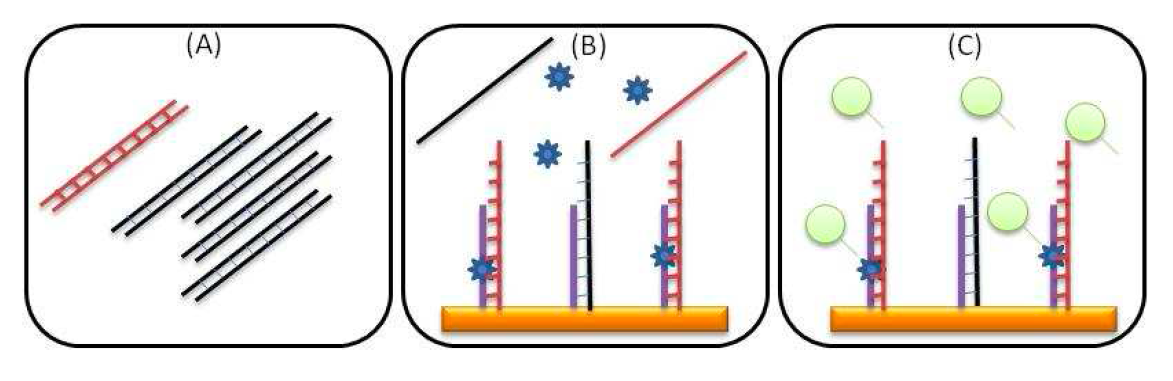
Liquid Biopsy detection protocol

Schema for complete detection protocol:

(A) Extracted DNA containing mutant (red) and wild type DNA fragments (black) are enzymatically amplified.

(B) Denatured amplicons are hybridized on surface immobilized DGL probes. Chemical locking of a specific tagged SMART base takes place only in the appropriate position.

(C) Incorporated SMART bases are recognized by streptavidin and monitored in real-time during an acoustic measurement.
AWSensors | Scientific Technology
Privacy Overview / Resumen de privacidad

From this panel the user will be able to configure the cookies that the website can install in their browser, except for the technical or functional cookies that are necessary for browsing and using the different options or services that are offered.

The selected cookies indicate that the user authorises the installation in their browser and the processing of data under the conditions stated in the Cookie Policy.

The user can check or uncheck as they wish to accept or reject the installation of cookies.

COOKIES CONTROLLED BY THE EDITOR

Analytics
Property Cookie Purpose Term
awsensors.com _ga ID used to identify users in 2 years
awsensors.com _gat Used to monitor number of Google Analytics server requests when using Google Tag Manager Sesión
awsensors.com _gid ID used to identify users for 24 hours after last activity in 20 hours
Marketing
Property Cookie Purpose Term
google.com NID This cookies is used to collect website statistics and track conversion rates and Google ad personalisation in 7 months
HOW TO MANAGE COOKIES FROM YOUR BROWSER
Delete cookies from your device Cookies that are already on a device can be deleted by clearing the browser history, thus deleting the cookies from all websites visited.

However, some of the saved information (e.g. login data or website preferences) may also be lost.

Manage site specific cookies For more precise control of site specific cookies, users can adjust their privacy settings and cookies in their browser.
Blocking cookies While most modern browsers can be configured to prevent cookies from being installed on a device, this may require the manual adjustment of certain preferences each time a site or page is visited. In addition, some services and features may not work properly (for example, profile logins).
HOW TO DELETE COOKIES FROM MOST COMMON BROWSERS
Chrome http://support.google.com/chrome/answer/95647?hl=es
Internet Explorer. Version 11 https://support.microsoft.com/es-es/help/278835/how-to-delete-cookie-files-in-internet-explorer
Firefox. Version 65.0.1 https://www.mozilla.org/es-ES/privacy/websites/#cookies
Safari Version 5.1 https://support.apple.com/es-es/guide/safari/sfri11471/mac
Opera https://help.opera.com/en/latest/security-and-privacy/#clearBrowsingData

Desde este panel podrá configurar las cookies que el sitio web puede instalar en su navegador, excepto las cookies técnicas o funcionales que son necesarias para la navegación y la utilización de las diferentes opciones o servicios que se ofrecen.

Las cookies seleccionadas indican que el usuario autoriza la instalación en su navegador y el tratamiento de datos bajo las condiciones reflejadas en la Política de cookies.

El usuario puede marcar o desmarcar el selector según se desee aceptar o rechazar la instalación de cookies.

COOKIES CONTROLADAS POR EL EDITOR

Analíticas
Propiedad Cookie Finalidad Plazo
awsensors.com _ga ID utiliza para identificar a los usuarios en 2 años
awsensors.com _gat Se utiliza para monitorizar el número de peticiones al servidor de Google Analytics cuando se utiliza el Administrador de etiquetas Google Sesión
awsensors.com _gid ID utiliza para identificar a los usuarios durante 24 horas después de la última actividad en 20 horas
Publicitarias
Propiedad Cookie Finalidad Plazo
google.com NID Estas cookies se utilizan para recopilar estadísticas del sitio web y rastrear las tasas de conversión y la personalización de anuncios de Google en 7 meses
CÓMO GESTIONAR LAS COOKIES DESDE EL NAVEGADOR
Eliminar las cookies del dispositivo Las cookies que ya están en un dispositivo se pueden eliminar borrando el historial del navegador, con lo que se suprimen las cookies de todos los sitios web visitados. Sin embargo, también se puede perder parte de la información guardada (por ejemplo, los datos de inicio de sesión o las preferencias de sitio web).
Gestionar las cookies específicas del sitio Para tener un control más preciso de las cookies específicas de cada sitio, los usuarios pueden ajustar su configuración de privacidad y cookies en el navegador.
Bloquear las cookies Aunque la mayoría de los navegadores modernos se pueden configurar para evitar que se instalen cookies en los dispositivos, eso puede obligar al ajuste manual de determinadas preferencias cada vez que se visite un sitio o página. Además, algunos servicios y características pueden no funcionar correctamente (por ejemplo, los inicios de sesión con perfil).
CÓMO ELIMINAR LAS COOKIES DE LOS NAVEGADORES MÁS COMUNES
Chrome http://support.google.com/chrome/answer/95647?hl=es
Internet Explorer. Versión 11 https://support.microsoft.com/es-es/help/278835/how-to-delete-cookie-files-in-internet-explorer
Firefox. Versión 65.0.1 https://www.mozilla.org/es-ES/privacy/websites/#cookies
Safari Versión 5.1 https://support.apple.com/es-es/guide/safari/sfri11471/mac
Opera https://help.opera.com/en/latest/security-and-privacy/#clearBrowsingData